Move beyond WhatsApp and Excel: what a good CRM must do, how WhatsApp Business API fits, and whether to buy HubSpot or Zoho or build a custom CRM.
A Pakistani business needs a proper CRM once customer conversations, leads and payments live in more places than one person can remember: WhatsApp chats, personal phones, Excel sheets and paper. A CRM (customer relationship management system) gives every lead an owner, a status, a history and a next action, so follow-up stops depending on memory. For most small and mid-sized companies the real question in 2026 is not whether to adopt one, but whether to buy HubSpot or Zoho, or build a custom system. This guide gives a practical way to decide.
The WhatsApp and Excel problem
Much local business runs on WhatsApp, and that is fine: customers want to message you there. The trouble starts when WhatsApp is also the database. Symptoms will sound familiar:
- Enquiries arrive on the founder's phone, a sales rep's personal number and Facebook inbox, and nobody has the full picture.
- A rep leaves and takes the chat history, the promises made and the customer's context with them.
- Excel sheets exist in several versions, with different phone number formats and duplicate rows.
- Nobody can say how many leads were contacted this week, which stalled, or why deals were lost.
- Quotes and invoices are separate files, so it is unclear who owes what.
None of this needs a large system to fix, but it does need one shared place where every customer interaction is recorded.
Lead follow-up is where revenue leaks
Most lost deals are not rejected; they are forgotten. A lead asks for a price, gets a reply, and then no one follows up. A CRM fixes this with owners, tasks and reminders: every open lead has a next step with a date, and anything overdue is visible to the manager. Even a simple pipeline (New, Contacted, Quoted, Negotiating, Won, Lost) with a required lost reason will tell you more about your sales process than any spreadsheet.
WhatsApp Business API
There are two WhatsApp products to know about. The WhatsApp Business app is a free app for small teams on phones. The WhatsApp Business Platform (the API) is for automation and multiple agents, accessed through Meta or an approved provider, and it has rules: businesses need customer opt-in, and outbound messages outside the customer service window use pre-approved templates, which are priced by Meta. Check Meta's current documentation for the pricing categories and policies before you plan a workflow.
What matters for a CRM: the conversation should be linked to the lead record, messages should be logged, any team member should be able to pick up the thread, and template messages (order confirmation, payment reminder, appointment) should be triggered by CRM events instead of typed by hand.
Local invoicing and payment realities
Generic overseas CRMs are built around card payments and standard sales tax. Pakistani businesses commonly deal with bank transfers, cash, cheques, mobile wallets such as JazzCash and Easypaisa, cash on delivery for products, and tax invoicing needs that vary by business type and registration. Requirements differ between businesses, so confirm your obligations with your accountant. From a system point of view, look for: PKR as the primary currency with multi-currency for export clients, partial payments and instalments, payment status per invoice, customer-facing quotes and invoices that match your format, and export to whatever your accountant uses.
What a good CRM must do
- Capture leads from every channel (website forms, WhatsApp, Facebook and Instagram, calls, walk-ins) into one list, with duplicate detection on phone number.
- Give every lead an owner, a pipeline stage and a dated next action.
- Keep a timeline per contact: calls, messages, notes, quotes, invoices.
- Support roles and permissions, so a sales rep sees their leads and a manager sees everything.
- Produce simple reports: leads by source, conversion by stage, revenue by rep, overdue follow-ups.
- Handle quotes, invoices and payments, or integrate cleanly with the tool that does.
- Let you export your data at any time.
- Work well on mobile, because your team will use phones.
Build versus buy
| Option | Strengths | Watch out for |
|---|---|---|
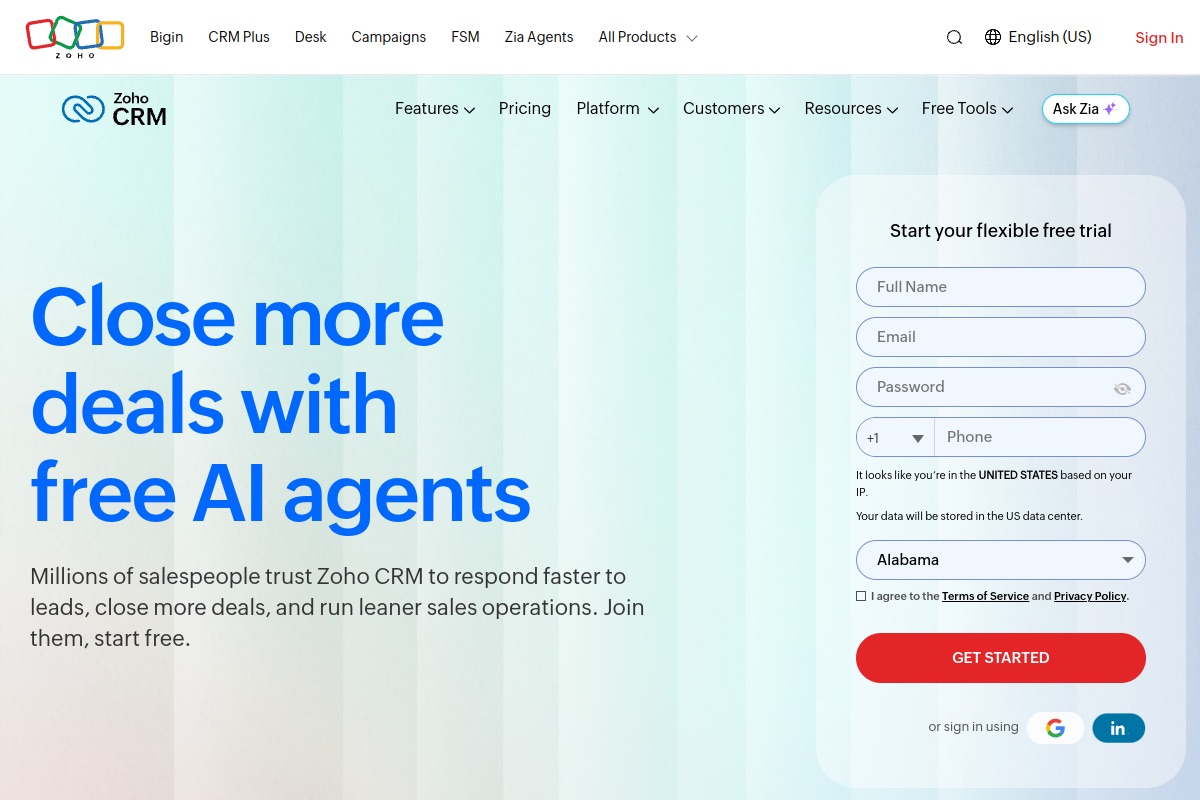
| HubSpot | Polished, strong marketing and email tools, a free CRM tier to start with | Costs rise as you add seats and higher tiers; billing in foreign currency |
| Zoho CRM | Broad ecosystem (invoicing, desk, campaigns), flexible customisation | Configuration takes real effort; local workflows still need adapting |
| Custom (for example Laravel) | Built around your process, local payment and invoice flows, WhatsApp integration, no per-seat fees, you own the data | Upfront build cost and ongoing maintenance; you need a reliable developer |
Our rule of thumb: if you have a standard sales process and fewer than a handful of users, start with a free or low-tier HubSpot or Zoho account and see whether the team really uses it. If your process is unusual (project delivery, installments, field teams, agency billing, WhatsApp-first sales), or you would otherwise stitch together five tools, a custom system is worth pricing. A hybrid also works: buy for the standard parts and build the pieces that differ.
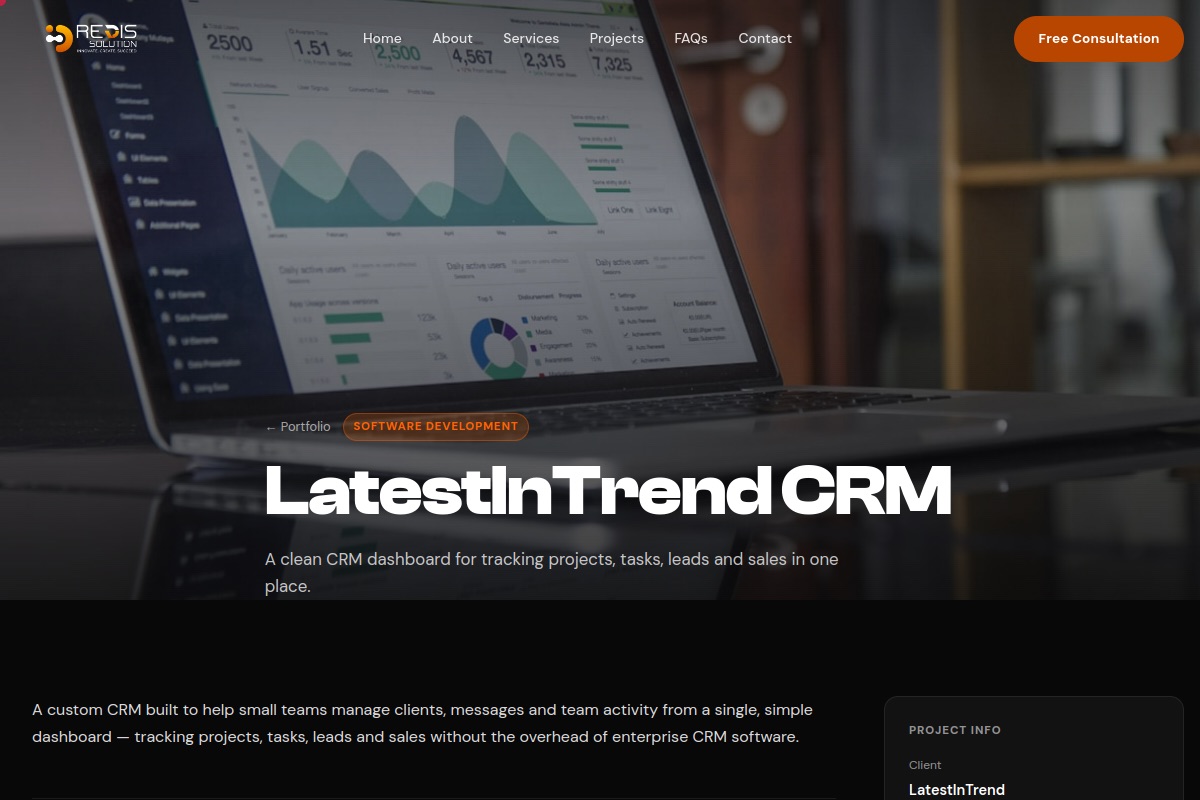
We build custom CRMs ourselves, and we have a portfolio example of a compact one built for a small team, tracking projects, tasks, leads and sales in one dashboard.
How to roll out a CRM without it dying in month two
- Start with one pipeline and five required fields, not fifty.
- Import your existing sheets once, cleaned, and then retire them.
- Make the CRM the only place where a lead counts: if it is not logged, it does not exist for commission or reporting.
- Review the pipeline in a short weekly meeting straight from the CRM screen.
- Add automation (WhatsApp templates, reminders) only after the basics are habitual.
Frequently asked questions
Is a CRM worth it for a small business in Pakistan?
Yes, once more than one person talks to customers or you lose track of leads. Start small; even a free tier is better than chat history and spreadsheets.
Can a CRM integrate with WhatsApp?
Yes, through the WhatsApp Business Platform via Meta or an approved provider, subject to opt-in and template rules. Custom CRMs can integrate it directly; HubSpot and Zoho offer integrations or partner connectors.
How much does a custom CRM cost?
It depends entirely on scope: number of modules, roles, integrations and reporting. A focused first version is far cheaper than a full platform. Ask for a fixed-scope estimate.
HubSpot, Zoho or custom?
Buy when your process is standard and you want speed. Build when your workflows, payments or integrations are specific to you and per-seat fees or workarounds would add up.
Talk to us about your CRM
We can help you choose between off-the-shelf and custom, and build the system if custom fits. See our services and portfolio, or get in touch for an honest recommendation.